
A Place for Everyday Essentials
A compact wall mirror and side-storage concept for the objects that rarely find a permanent home.
Concept study: hypothetical brief and AI-generated design imagery, not a delivered project or order-ready specification. Dimensions, finishes, connections and installation require development review.
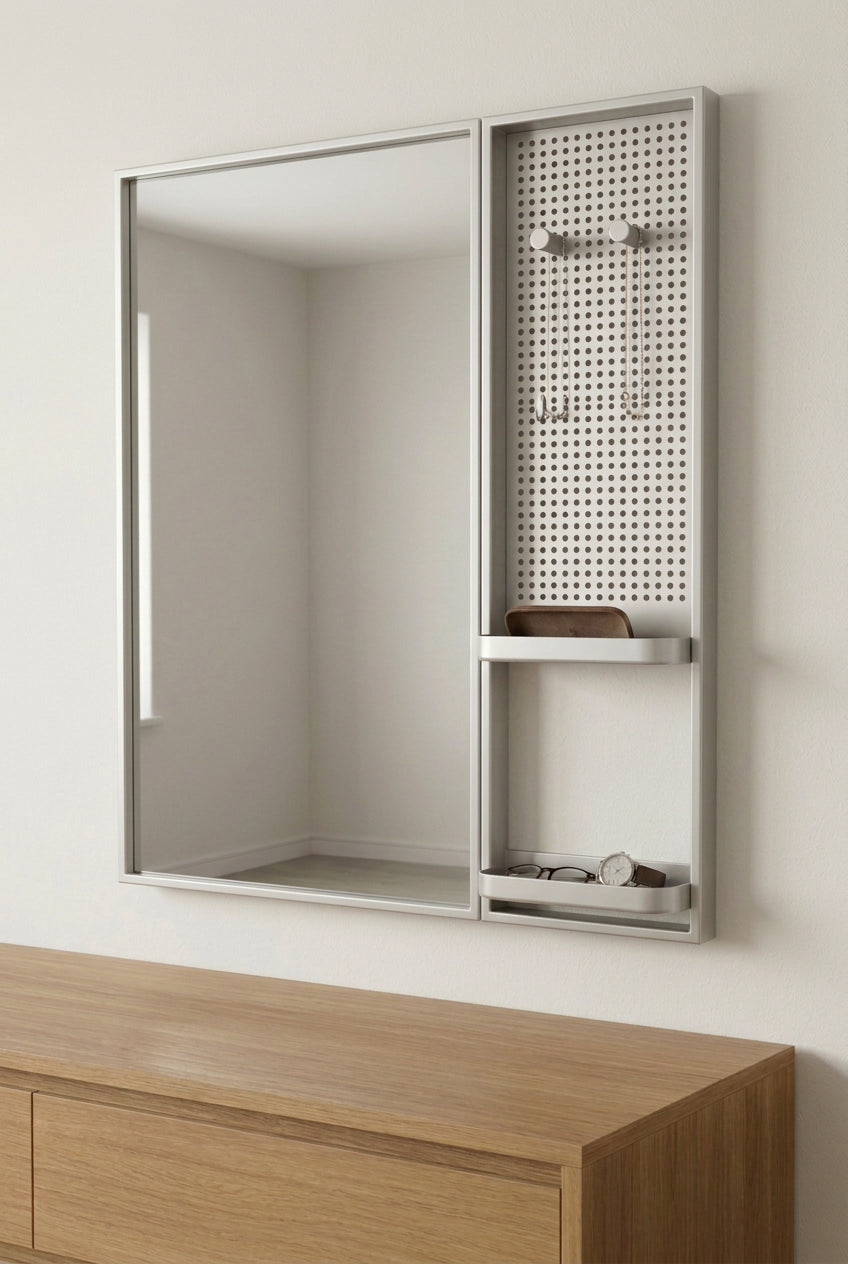
Keep the dresser. Reconsider the wall.
Assume an existing bedroom or entrance dresser already holds larger and less-used belongings, yet glasses, a watch and a few pieces of jewellery collect on top. The brief is an upper-body mirror and deliberate homes for daily objects, not a new deep cabinet or full-length dressing mirror.
Customize This DesignUseful clearance
Start with the actual case and the hand space needed to grasp and retrieve each object. Test real items rather than assuming a nominal gap is useful.
Compact, clear reflection
Keep the organiser’s useful width, height and depth unchanged; reduce mirror width and overall unit width instead. Keep shelves clear of the glass. A 6:4 front-width relationship is a visual study target, not a manufactured dimension.
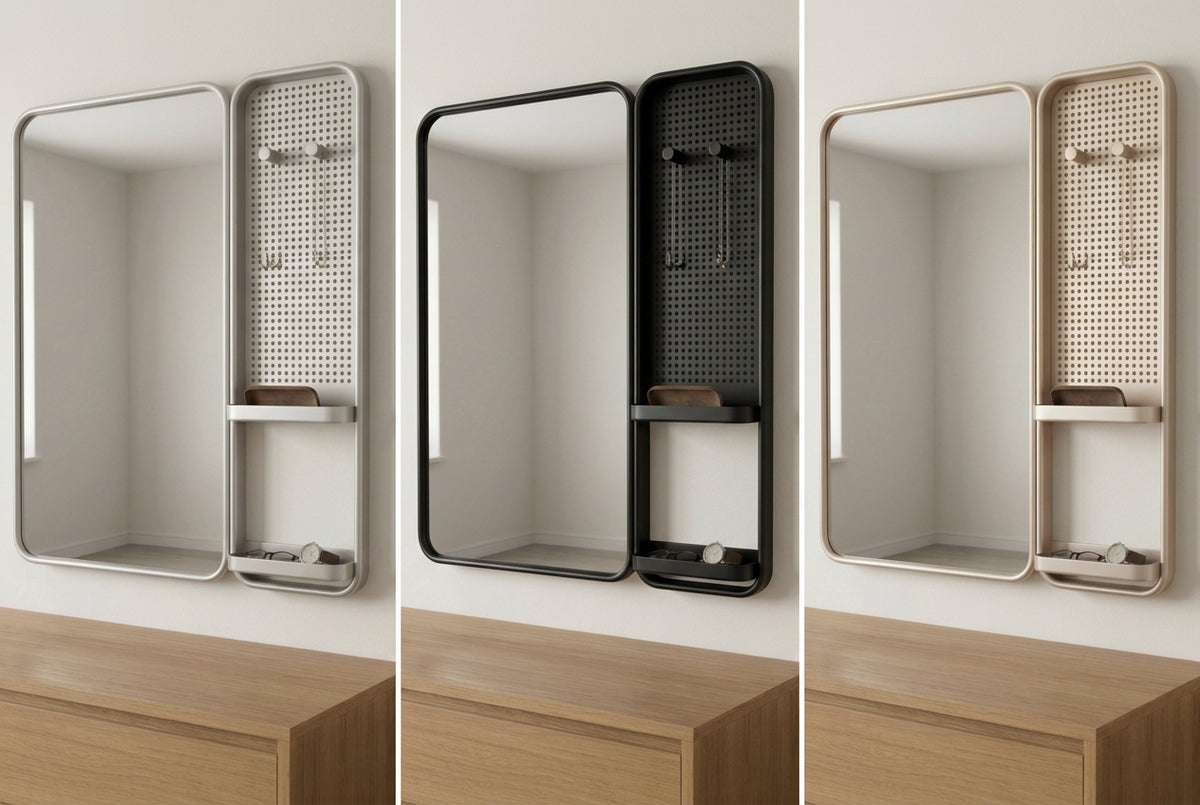
Softly radiused, in three finish directions
The mirror frame and side organiser retain consistent rounded-corner treatment within one coordinated assembly. Silver, matte black and warm champagne explore a coordinated finish across the frame, insert and trays. Final colours and surface quality require physical sample approval.
Left or right, planned around your space
Choose left or right at the briefing stage. Both arrangements are intended as a connected mirror-and-storage assembly installed as one unit. Consistent corner treatment preserves the design language when the side position changes.
Keep the organiser’s useful dimensions unchanged and adjust mirror width to control overall size. Final joints and mounting require development review.
Build Your Design Brief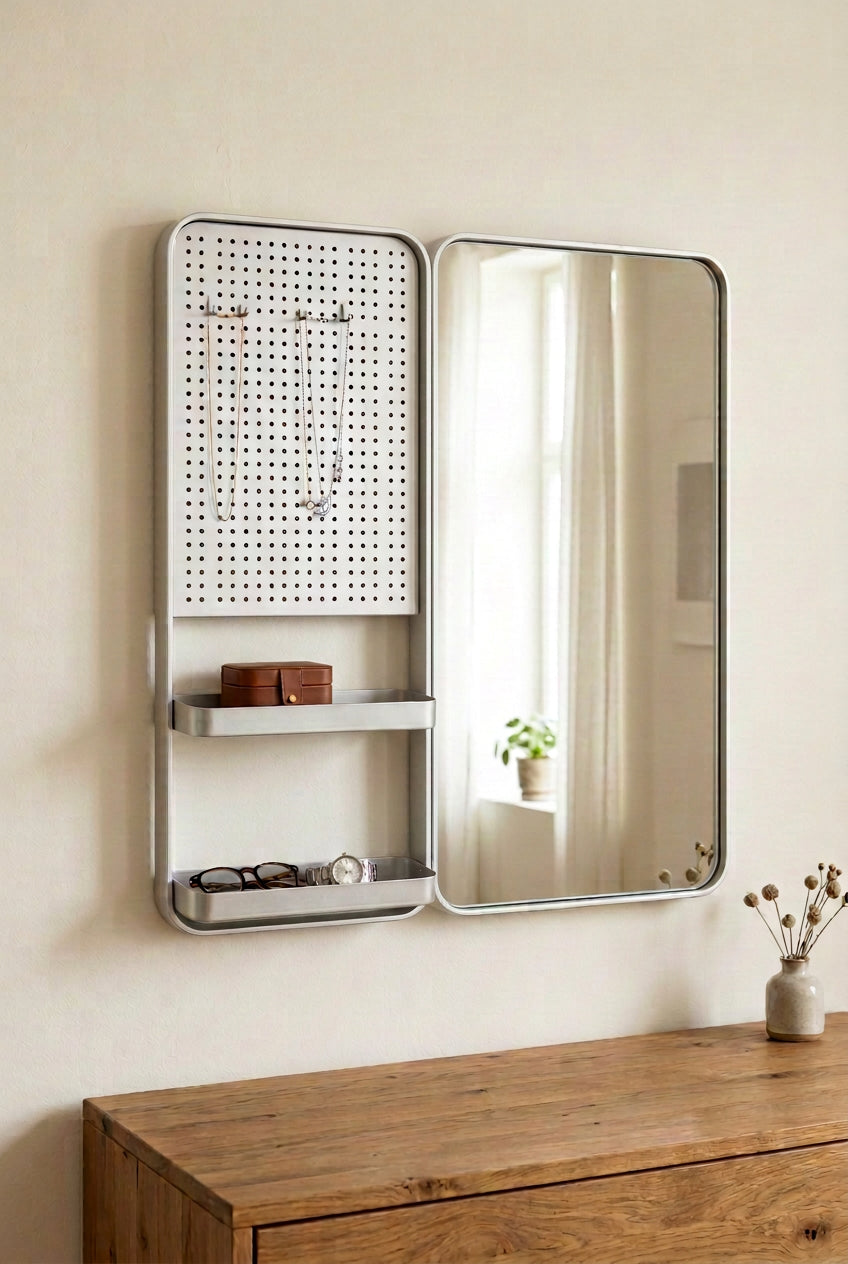
Left-positioned, joined as one unit
The side organiser sits directly beside the mirror, forming one compact assembly without exposed bridging bars. The design intention is to mount the connected product as a whole, not hang the parts separately.
Left or right is a configuration choice for development. Keep the organiser’s useful dimensions as the reference when refining mirror width; final concealed connections, support and wall fixing require review.
Space and layout
Left-side or right-side organiser. Develop the position around available wall area, dresser height, adjacent furniture and the approach to daily objects. Mirror and organiser are intended to connect as one product and be mounted as a complete unit, subject to mounting and interface review.
Objects and configuration
Mixed use is the lead direction. Tray-led or hanging-led arrangements are future development discussions, not a confirmed modular catalogue. Purchase-stage configurations are not user reassembly or universal pegboard accessories.
Brand expression
Frame style, finish samples, marking and packaging requests can be assessed. An illuminated version is a separately assessed branch, with power, heat, wiring and service considered separately—not a comparison shown here.
Trade-offs—and when to reconsider
Open storage needs tidying and cleaning. Shallow trays do not accommodate bulky bottles, and a narrower reflection sacrifices viewing width.
Choose a standalone mirror if daily storage already works; consider an enclosed format if concealment is essential. A full-length mirror or simultaneous users call for a different brief.
Three checks before specification
1. Real-item mock-up: check the case, hand clearance, hook retention and hanging-item collisions with actual objects.
2. Structure and installation: assess glass retention, joints, loaded behaviour, wall fixing, left/right assembly and service. The intended installation principle is one connected product mounted as a whole; final details need review.
3. Packaging: compare assembled versus separate-component packing, glass and tray protection, packed dimensions and assembly burden. This packaging comparison does not imply separate wall mounting. No automatic cost savings are assumed.
If lighting is considered, assess power, heat, wiring and service separately.
Shape this concept around your brief
The next page opens the Mirror & Side Storage series. Select Customize this design on the Mirror & Side Storage — Concept Study card to begin your brief.
Generate and review your brief, edit it if needed, then copy it and paste it into the contact-page message. Submit your message there; the design selector does not send the request for you.
Explore Customize Our Designs · Back to Reflection with Open Storage
This is a concept study, not an order-ready specification or automatic enquiry; dimensions, finishes, connections and installation require development review.
Discuss Your Configuration