
Fitting-Room Mirror
A full-length mirror. A separate place for clothing.
Concept visual and explanatory sketches are AI-generated; they are not production samples, historical workshop drawings or delivered projects.
A clear view, without a crowded frame
The concept keeps the reflective area visually uninterrupted within a slim silver soft-radius frame. A three-hook strip is a separate, optional garment zone—not hardware carried by the mirror frame—so its position can be considered independently.
We recommend beginning with the unlit mirror. A lighting branch can be considered separately after comparing the room and viewing conditions.
Continue to the Fitting-Room Mirror series, then select Customize this design on its concept card to build your brief.
Customize This Design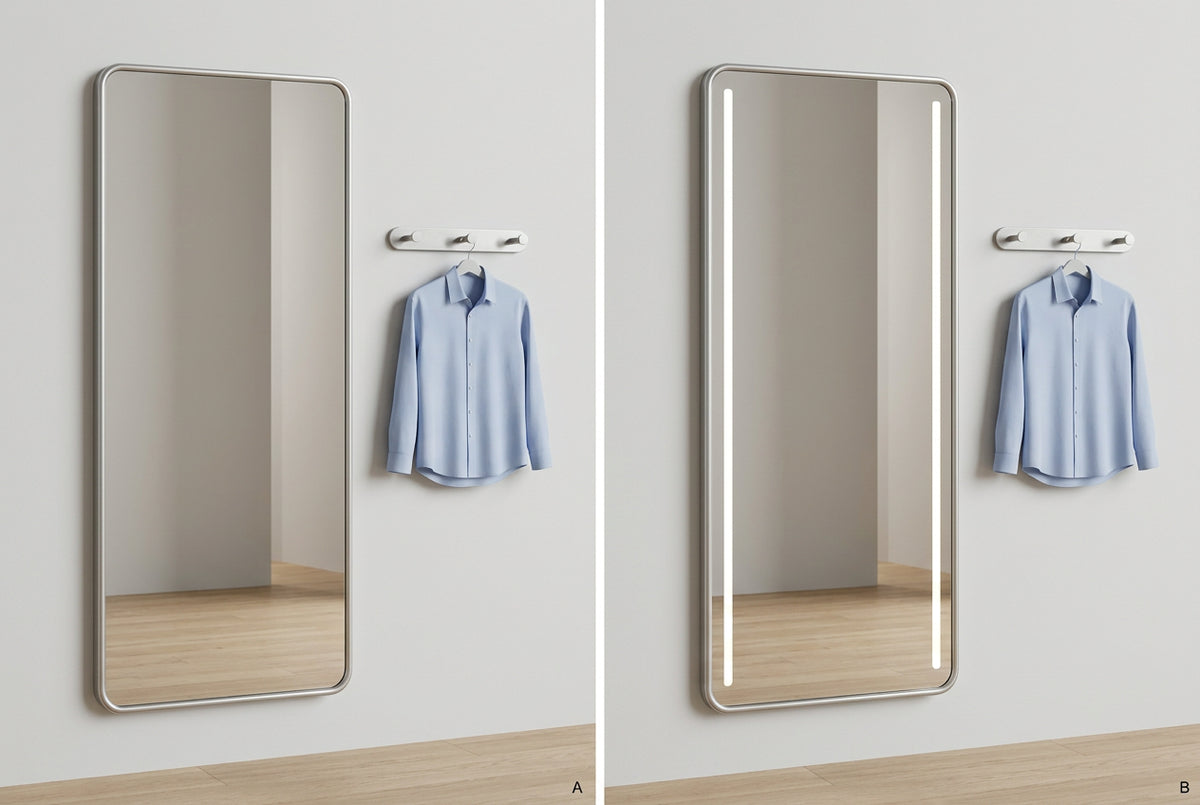
Three decisions behind the design
Protect the mirror area. Keep trays and hanging points off the frame and outside the reflective area, so the mirror remains a clear, simple object rather than a crowded storage unit.
Keep the garment zone independent. A separate hook strip allows its location to be considered for the room. That creates two fixing positions to specify and assess—the mirror and the hook strip—not a single integrated mounting system.
Treat lighting as a branch. Lighting follows the same mirror outline, but it is not the default upgrade. Compare an unlit option first and develop lighting only when the room and brief support it.
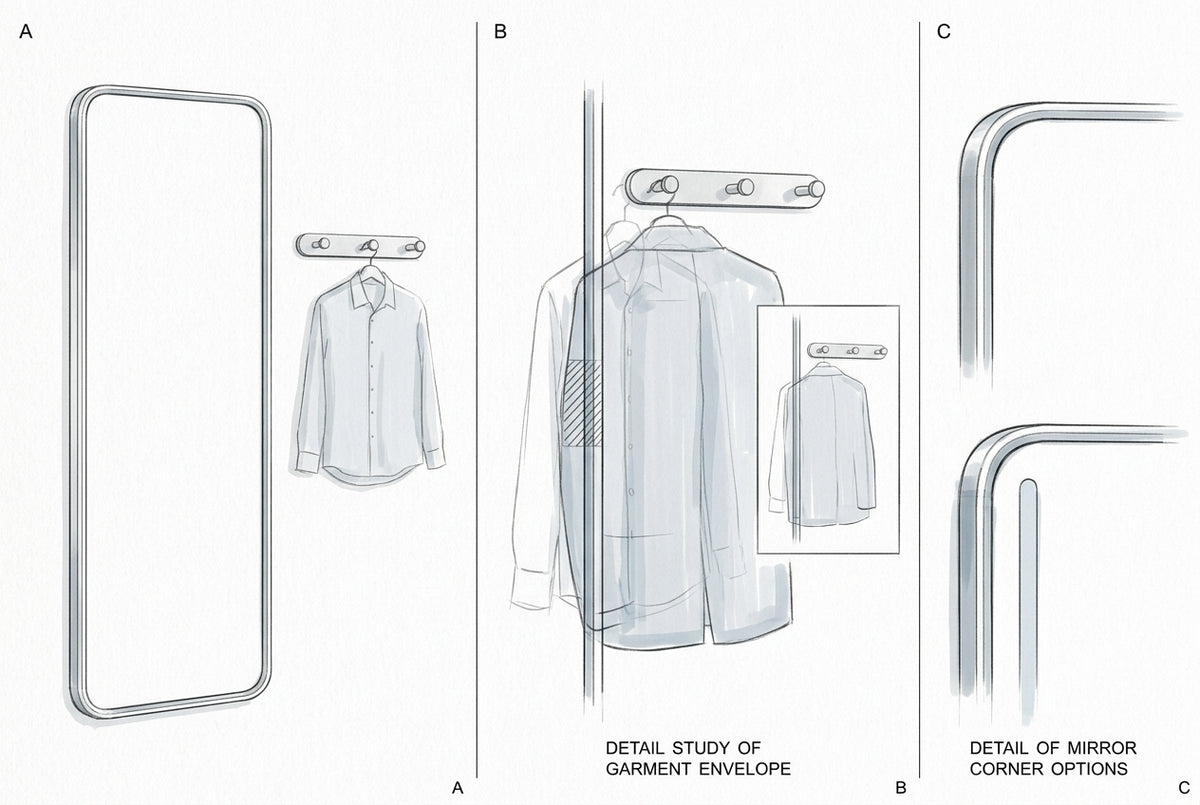
From the mirror outline to the garment envelope
The board relates a full-length mirror to a separately located three-hook strip. It is a visual explanation of scope, not a verified arrangement.
A — Compare the mirror outline with the independent hook location. B — The wide garment envelope reaches toward the mirror edge; the hatched area marks an issue to test. The small inset does not verify that separation is solved. C — An ordinary corner and an internal vertical diffuser illustrate possible visual details, not electrical engineering.
These are retrospective AI-generated explanatory sketches, not original historical records. Clearances, mounting positions and loads have not been measured or verified.
Our recommended development starting point
Begin with an unlit, silver-frame wall mirror. Resolve dimensions, usable viewing area and mirror mounting first. Consider the optional separate hook strip only after testing the position with actual garments.
Explore a lighting branch after comparing it with the room. A mobile freestanding mirror, integrated storage or a high-capacity wardrobe brief may need a different architecture.
Build Your Design Brief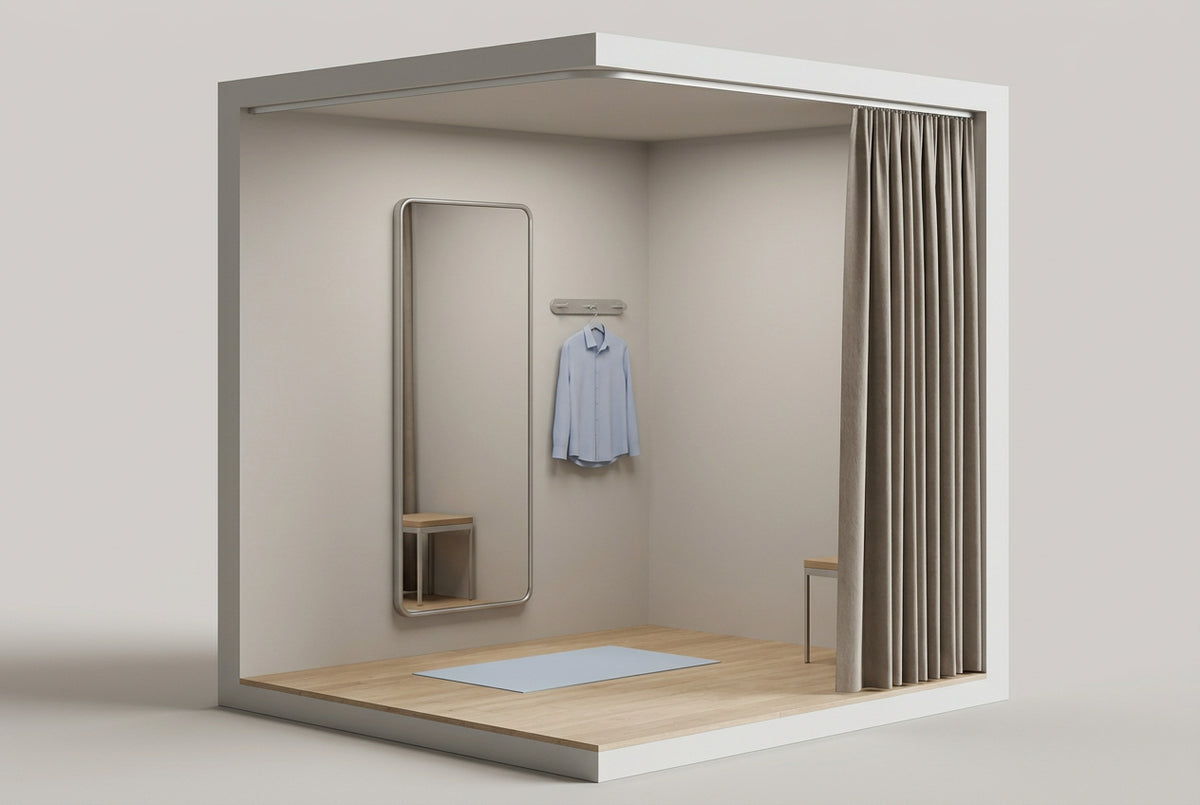
Specify the mirror around a real fitting room
The mirror, curtain, seat and hanging garments must be considered together. Use the scene to identify what needs testing with your actual room dimensions and clothing.
Configuration questions to resolve
Dimensions and proportion: distinguish fixed requirements from wall and viewing dimensions still to review. Frame and edge: silver is the proposed direction; no unverified color variants are represented as available. Scope: mirror only, or mirror with a coordinated but separately mounted hook strip. Lighting: share room conditions and requirements for separate review; no performance is promised.
To shape the discussion, include target market, cubicle or store count, indicative quantity, branding and packing needs. No minimum order quantity or lead time is established here.
A four-stage sample review
1. Form and finish. Review the mirror outline, silver-frame direction, edge treatment and proposed scope.
2. Full-size use and mounting. Assess standing view, dimensions, mirror fixing and—if requested—the separately mounted hook strip with actual clothing.
3. Lighting, if needed. Compare room conditions and discuss lighting only as a separate branch; no performance is assumed.
4. Packing and repeat supply. Review packing, branding, quantities and timing for the brief. This is a review stage, not a supply or lead-time promise.
Discuss your version of this mirror
For a useful first discussion, share your room reference, mirror-only or separate-hook-strip scope, lighting interest, target market and indicative quantity. Ask whether you need a specification review or design advice.
The next page opens the Fitting-Room Mirror series. Choose the Fitting-Room Mirror — Concept Study card to begin your brief. Generate and edit the brief, copy it, then paste it into the Message field on the contact page and submit it there; the selector does not send your request.
Prefer to discuss the project directly? Contact us.
Back to the two-cubicle fitting-room mirror study.
Customize This Design